


A Frame Desk Guide for Home Offices and Cabins

You know the moment. The room is measured, the tape is back in the drawer, and the question still hangs in the air, will this A frame desk fit the corner, the cabin wall, or the narrow stretch between a window and a closet without feeling cramped? That one decision, the frame width and top size, controls almost everything else, from how steady the desk feels when elbows land on the edge to whether the chair can pull back without clipping the wall.
A good desk choice starts with the shape of the base. A frame desks use a triangular stance, so they can look lighter than a four-leg desk while still giving a room a clear working surface. That's why they show up so often in small home offices, loft corners, and mountain cabins where every inch has a job.
Ruidoso homeowners and cabin owners also deal with rooms that get used in different seasons, so the desk has to feel dependable all year. It shouldn't look delicate or demand babying, it should behave like a workhorse that settles into the room and does its job.

If a room also needs storage for a rolling cart, a slim organizer, or small bedside-style pieces, a compact layout matters even more, and a quick look at a 6-drawer rolling cart option can help shape the whole setup.
Why an A Frame Desk Is the First Choice for Flexible Spaces
The shape solves a common space problem
The easiest way to understand an A frame desk is to picture a desk that doesn't visually overload a room. The legs splay outward instead of dropping straight down, so the base feels airy while still giving the top a defined footprint. That makes the form useful in spots where a bulky workstation would dominate the room.
Practical rule: if the room feels tight before the desk arrives, a lighter-looking base can make the space feel usable instead of crowded.
This form works especially well in a corner, against a cabin wall, or in a narrow office nook where the desk has to live beside a bed, a sofa, or a closet. The point isn't style for its own sake, it's giving the user a work surface without forcing the room to become a dedicated office.
Why it fits mountain homes so well
Cabins and mountain homes often need furniture that feels calm but still handles real use. A wood or metal A frame desk can do that without looking out of place beside rustic trim, painted beadboard, or a modern guest room setup. It's a practical choice for people who want a workstation that can stay in place year-round and still match a room that changes with the season.
The form also helps first-time buyers because it's easy to read visually. You can usually tell at a glance where the load goes, where the knees go, and where the chair needs to fit. That clarity matters more than flashy features when the room is small and the desk has to work every day.
A quick mental picture of fit
Before looking at finishes or accessories, stand in the room and ask three questions:
- Where does the top begin and end? The desk should feel centered, not squeezed into the wall.
- Where do the knees and chair go? If the chair can't pull back comfortably, the desk is too deep for the room.
- What sits beside it? A window, a closet, or a sleeping area changes how much visual weight the desk can carry.
A frame furniture made for flexible spaces works best when the room already has constraints. That's why so many buyers in Ruidoso and Lincoln County start with this shape when they need something practical, not oversized.
How the A Frame Desk Form Came to Be
From portable writing boxes to a standing work surface
The A frame desk didn't appear out of nowhere. It belongs to a long line of writing furniture that started with portable forms and slanted lids, then evolved into more specialized desks over time. Furniture-history sources trace desk development back to earlier writing forms in the 17th century, note the earliest known desk evidence as dating to the 14th century, and place the first real step toward a writing-specific desk around 1650. One historical account also places the desk on a frame in Colonial America and ties it to the Queen Anne style in the broader early-18th-century Anglo-American tradition. Desk on a frame history
That matters because the modern A frame keeps the old priority, usefulness first. The split between top and support, and the idea of a desk that can be moved or adapted to a room, still shows up in today's builds.
Why the 19th and early 20th centuries changed desk design
By the 19th century, desk-based work had spread much further as industrialization and cheaper paper increased office use, and one furniture history notes an explosion in the number of people working primarily at a desk during that century. In the late 1880s, Anna Breadin's one-piece school desk patent showed that desks were being engineered for specific jobs, not just built as generic writing tables. In the early 20th century, typewriters and heavy paperwork pushed desk construction toward steel and more integrated forms. Desk history and design shifts
The old pattern is simple, once more people used a desk for more hours of the day, the furniture had to become sturdier, more standardized, and easier to mass produce.
That's why the modern A frame desk feels like a descendant rather than a novelty. It still reflects the older idea of separating structure from surface, then tailoring the shape to the task. The next question is how the geometry carries weight without wobble.
Understanding A Frame Geometry and Why It Matters
The load path is the whole story
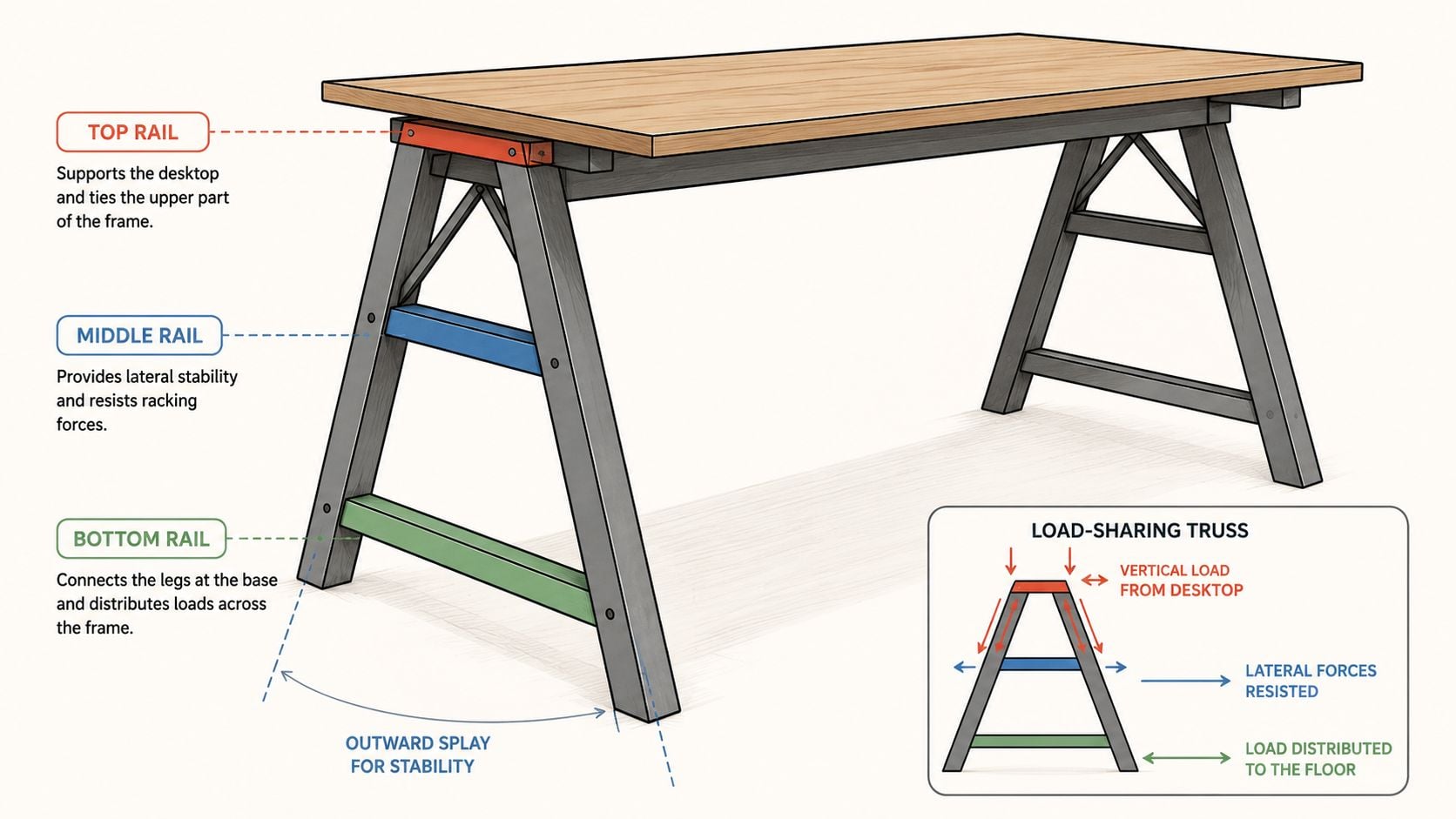
An A frame desk usually uses three A-frame sides, and each side is built from two legs plus top, middle, and bottom rails. A published plan also specifies 2 1/2-inch pocket holes, wood glue and clamps, and a top frame that leaves the desktop with a 1/2-inch overhang on all sides. Those details are not decorative, they control how the desk carries load and resists side-to-side movement. Kreg A-frame desk plan
Think of the frame like a bridge truss. The desktop loads travel down the angled legs into the floor, while the rails keep the legs from twisting inward or racking outward. If the rails are weak or the proportions are off, the desk can still look fine in a photo and feel loose in real life.
Why width classes matter
A published A-frame system comes in top widths of 120 cm, 140 cm, 160 cm, and 180 cm. Those sizes show that the frame geometry is scaled to a defined desktop span, not guessed on site. A-frame desk system widths
That scaling is important because a wider top increases usable surface area, but it also raises the need for torsional rigidity at the joints and stretcher connections. In plain language, longer spans have more force, so the frame has to resist twisting when the user leans on one side or sets gear off center. When the proportions look balanced in the photo, the desk is usually better prepared for daily use.
What the eye should check first
Before buying, look at the relation between the top and the base. If the top seems to float far beyond the legs, the desk is more likely to feel lively under load. If the feet seem too close together for the width of the desktop, the frame may be fighting the furniture instead of supporting it.
A useful visual test is simple, the legs should look like they belong to the top, not like they were borrowed from a smaller desk. That instinct often lines up with the actual load path.
Comparing Wood, Metal, and Concrete A Frame Builds
Three materials, three very different jobs
Material choice shapes how the desk feels in the room and how much effort the build demands. Wood is the friendliest option for a cabin or guest room, metal suits a clean modern office, and concrete creates mass and permanence for someone who wants the desk to feel anchored.
The construction details also tell the story. One plan uses pocket-hole joinery with 2 1/2-inch pocket holes, wood glue, clamps, and a 1/2-inch overhang on all sides. Another uses 2×2 boards for the legs and supports, 2-inch wood screws, and drawers built from 1×3 boards. A concrete-desk guide uses 3/4-inch melamine sheet for the mold, 2-inch-high sides, and a mix of 1 part cement to 3 parts sand with water added until it reaches the texture of thick oatmeal. Concrete desk form and mix guide
Here's a quick comparison for scanning the tradeoffs.
| Material | Typical Weight | Build Skill | Best Room Fit |
|---|---|---|---|
| Wood | Light to moderate | Beginner to intermediate | Cabin rooms, small home offices |
| Metal | Moderate | Intermediate | Modern offices, heavier everyday use |
| Concrete | Heavy | Intermediate to advanced | Permanent workspaces, anchored studio rooms |
What each material does well
Wood feels approachable, and the joinery details are forgiving for a first build. It's the easiest material to blend into pine walls, rustic trim, or a room that already leans warm and natural.
Metal gives the desk a sharper profile and often pairs well with cleaner lines, which is useful in a work-from-home setup that needs visual order. A frame desk with a metal base can also handle a more industrial look without adding visual bulk.
Concrete is the most committed choice. It's for someone who wants the desk to stay put, absorb visual noise, and feel substantial. The tradeoff is handling the mold, cure time, and final weight, which makes it far less casual than wood.
Why a cabin buyer usually starts with wood
A wood A frame desk fits well in rooms that already have natural texture. It can warm a painted wall, soften a spare corner, and feel at home beside lodge-style decor without turning the room into a workshop. For buyers in Ruidoso or the surrounding mountain communities, that balance often matters as much as the size.
If the room also needs pieces that share a rustic style, a matching accent piece from a rustic decor collection can help the whole space feel intentional. The desk then reads as part of the room, not as a stand-alone project dropped into it.
Sizing Rules That Keep an A Frame Desk Stable
A desk frame can look right in the room and still feel wrong once it carries real work gear. Two monitors, a printer, and a hand resting on one edge all change how the load moves through the frame, so size and support have to be checked together. That is the part many first-time buyers miss, and it is usually where wobble begins.
Stability comes from matching the frame to the top
The first rule is simple, the desktop has to match the frame width class instead of being chosen by eye alone. A frame that is too narrow for the top leaves too much mass hanging outside the support line, and that is where movement starts showing up during normal use. Independent Desk frame sizing guidance also says to keep front and side overhang to about 4 to 6 inches, and to size the frame for the full load of monitors, arms, and peripherals rather than the tabletop alone.
The second rule is to think about off-center pressure. A leaning elbow, a printer, or a monitor arm all push the desk unevenly, so the frame has to resist torsion, not just straight downward weight. Overhang is part of the stability equation, not a cosmetic detail.
Load rating needs breathing room
A practical frame-selection habit is to leave margin above the actual load. For sit-stand guidance, the common advice is to over-spec the frame capacity by 20 to 30 percent, and that same logic helps static A-frame setups because heavy gear rarely stays perfectly centered. The same guidance also recommends a 12 to 20 inch service loop for moving cables, which matters when the layout needs to stay clean and adjustable. Sit-stand frame planning guidance
Useful rule of thumb: the frame should be rated for the desk as used, not for the empty tabletop in a showroom.
A simple working example helps. If the setup uses a 60-inch top with two 27-inch monitors, a center printer, and the kind of elbow pressure that happens during long work sessions, the safer choice is a frame rated for at least 220 pounds even if the actual load is closer to 150. That extra margin helps the desk stay calmer under everyday asymmetry.
What buyers usually get wrong
Many people focus on wood species, finish, or drawer count before checking the frame width and load path. That is backwards. The desk will feel solid or wobbly long before anyone notices whether the stain was walnut or oak.
If a desk needs to handle a printer, monitor arm, and daily leaning, the support geometry matters more than the decorative choices. A rustic end table collection can handle the style side of a room, but the desk itself still has to carry the weight without complaint. Once the frame is right, styling becomes the easy part.
Fitting an A Frame Desk Into Cabins and Small Offices
Small office nook
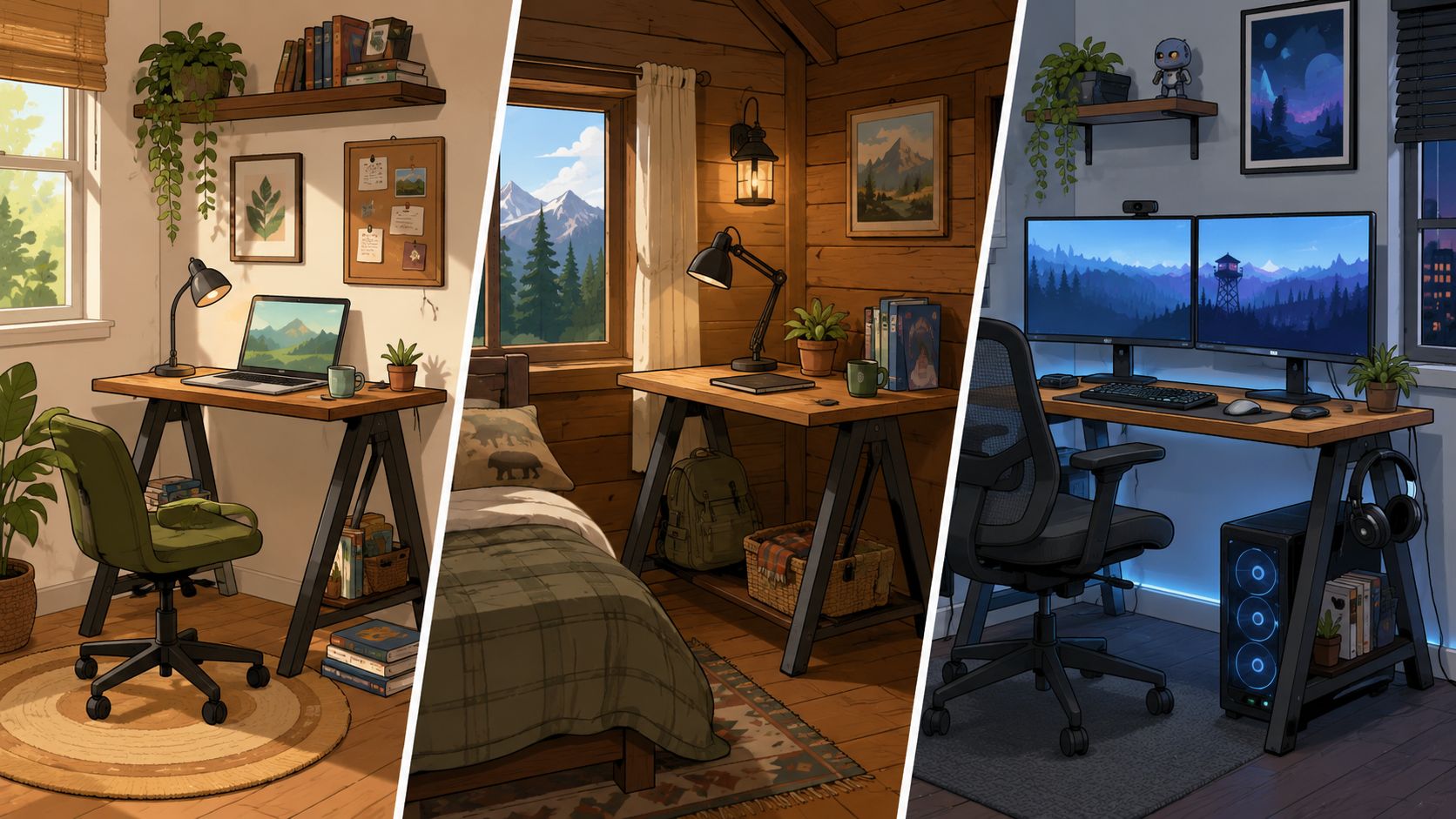
A small office nook works best when the desk sits with the room, not against it. Place the work surface so the strongest light comes from the side, because a window directly behind the monitor usually creates glare and makes the screen harder to read. Leave enough room for the chair to move back cleanly, and check that the desk does not block a door or closet swing.
Cable planning matters even on a fixed desk. The same kind of planning used for adjustable frames applies here, measure the space behind the desk, leave room for cords to bend naturally, and give yourself extra capacity so the setup does not feel crowded once the gear is in place. A little space behind the desk now prevents messy rework later. For a simple way to think through width, load, and cord space together, the route 54 home decor guide gives a useful reference point.
Ruidoso cabin guest room
A cabin guest room often needs the desk to do more than one job. It may need to serve as a writing surface, a makeup station, or a laptop spot, so it should sit where it can take in natural light without cutting into the room's main walking path. A wood frame usually fits this setting well because it feels warm against mountain textures and does not compete with the rest of the room.
Wall clearance deserves the same careful attention. Leave room behind the desk for cords, then give yourself a little more if a monitor arm might be added later. That small bit of planning keeps the desk from turning into a dead-end layout.
Dual-monitor work-from-home station
A dual-monitor setup needs a closer check on width and depth. The chair should slide in without the elbows crowding the edges, and the monitor stands or arms need space without pushing the work surface too far forward. A desk that carries this kind of load should feel centered in the wall space, not squeezed into it.
That is where width, load, and overhang come together in plain sight. If the top is too narrow, the setup feels like a tray balanced on a stool. If the frame is too small for the gear, every elbow press and small shift adds wobble. A buyer comparing room layouts in person can see that difference quickly, especially when looking at a Mattress Pro by Miller Waldrop home decor display and checking how the desk footprint sits beside the rest of the room.
If the room is tight, size the desk on paper first, then fit the rest of the room around it.
For local shoppers who want to compare desk layouts in person, a Ruidoso showroom on Sudderth Drive can make the size and finish decisions much easier, especially when paired with full-service delivery and professional setup. A real room test beats guesswork every time.
A Short Decision Checklist and Styling Tips
The one-screen checklist
A buyer can narrow the choice fast by checking five things in order:
- Pick the width class first. The top and the frame have to agree before anything else makes sense.
- Choose material by room and load. Wood for warmth, metal for clean lines, concrete for mass.
- Set overhang to 4 to 6 inches. That keeps the desk from feeling unsupported at the edges.
- Oversize the load rating by 20 to 30 percent. Monitors, arms, and accessories add up quickly.
- Plan cable paths and chair clearance before the build. A desk that fits on paper is easier to live with later.
Those five steps prevent most buyer regret. They also keep the desk from turning into a nice-looking problem.
Styling that still respects the structure
A stained wood frame can warm a pine wall and make a cabin corner feel finished without adding clutter. A black metal base can disappear into a modern office, which lets the monitors and chair do the visual talking. A slim leather runner or a simple drawer pull can dress up a basic build without changing the structure.
If the room leans rustic, a Mexican rustic decor reference can help the desk sit naturally inside the broader look. The goal is always the same, a desk that gets used because it feels right in the room.
A frame desks reward careful sizing more than fancy language. Once the width, load, and overhang are right, the whole setup feels calmer, sturdier, and easier to live with.
Common Questions About Choosing an A Frame Desk
Can an A frame desk hold two monitors and a printer? Yes, as long as the top matches the frame width class and the frame is sized for the full setup with a 20 to 30 percent margin. Is an A frame desk stable on carpet? Usually yes, because the splayed legs resist racking, but a hard floor or a low-profile chair mat helps keep the feet from settling unevenly over time. What's the difference between a desk on a frame and an A frame desk? A desk on a frame is the historical Colonial American form with a separate hinged writing box on a stand, while an A frame desk is a modern triangular-leg base built around a flat worktop.
Ready to turn a stressful room decision into a confident one? Mattress Pro by Miller Waldrop helps Ruidoso and Lincoln County shoppers compare sleep solutions with local guidance, including the Comfort Promise and the Low Price Promise. Visit Mattress Pro by Miller Waldrop to browse the selection, then stop by the showroom when you're ready for real help from people who live where you live.